



How can farmers obtain independent comparative data on the fuel consumption of tractors from different manufacturers to support their purchasing decisions? The German Agricultural Society (DLG) has taken on this challenge with its PowerMix tests, which provide highly valued information on energy efficiency in various work applications for both manufacturers and end users.
The DLG PowerMix tests are conducted at one of Europe’s most advanced test centers in Groß-Umstadt near Frankfurt. Using a roller dynamometer, the tests simulate a total of 14 different agricultural work tasks, ranging from ploughing and cultivation to road transport.
Fendt Vario tractors equipped with the new AGCO Power CORE diesel engines have performed exceptionally well in recent comparisons, achieving the best results in their respective power classes.
- Fendt 620 Vario with the CORE50 engine achieved the lowest diesel consumption of all tractors tested by DLG in the 165–240 hp power class.
- Fendt 724 Vario with the CORE75 engine and CVT transmission achieved the best average PowerMix results in its comparison group (240–310 hp) for fuel efficiency and performance.
- Fendt 728 Vario with the CORE75 engine and CVT transmission was the most economical in its power class (240–305 hp), with nearly 6% lower consumption than its competitors.
All DLG PowerMix test results are available in the DLG test database.
Similar results were also reported by Profi magazine (6/2025) when testing a Fendt 620 Vario tractor equipped with the AGCO Power CORE50 engine in practical field work. According to the magazine, the Fendt Vario is on average more than 10–15% more economical than all previous test candidates in mixed work and partial-load operation.

Independent Tests Benefit Both Users and Manufacturers
“Measurements carried out by an independent tester also provide unbiased information from the manufacturer’s perspective. The tractor is taken directly from the production line for testing, ensuring that the product corresponds to what end users actually receive,” says Matti Uotila from AGCO Power’s product development team.
According to Uotila, the structure of the DLG PowerMix 2.0 test closely reflects real-world, highly versatile end-user operating conditions.
Fuel and AdBlue consumption are measured on a roller dynamometer under typical operating loads. The field work phase of the test includes 12 work cycles, such as ploughing and cultivator operations. In addition, tractor efficiency in road transport is measured with both lighter and heavier loads. The tests also take into account the use of the power take-off (PTO) and hydraulics.
“The tests are not carried out only at full power, but at various load points and engine speed ranges, so they cover a very wide operating range of agricultural machinery. The results can also be applied to many other uses, not just agricultural work,” Uotila notes.
Top Results Are the Result of Engine and Tractor Working Together
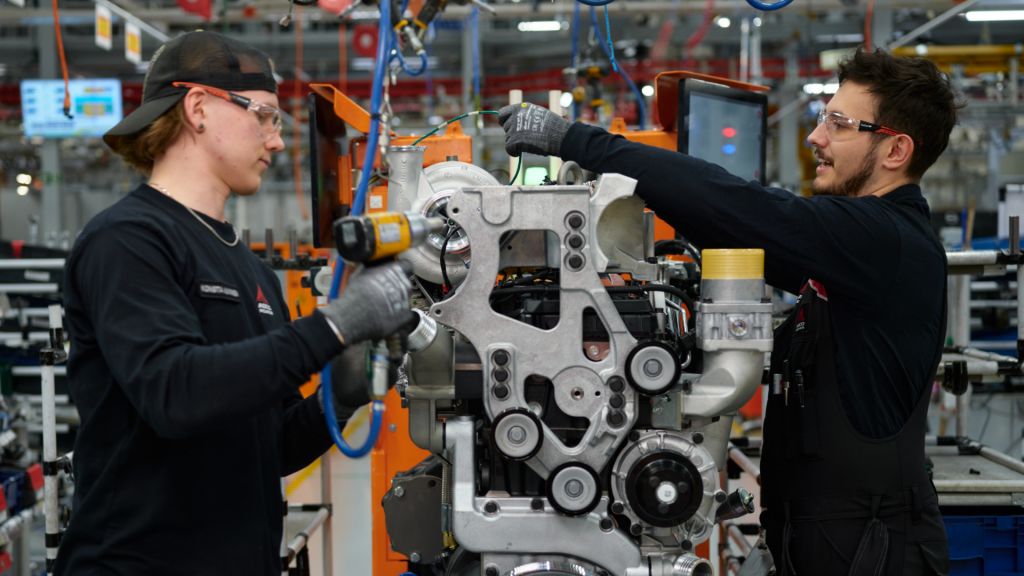
Uotila emphasizes that achieving the best possible fuel efficiency is not possible by refining engine or vehicle performance alone—both are required.
“The combination must be perfect to achieve a good end result. The foundation for Fendt’s good fuel efficiency was created through the tractor’s VarioDrive transmission and AGCO Power’s low-speed engine concept. The CORE engine family’s extremely wide maximum torque range, combined with the VarioDrive transmission, enables maximum utilization of the most efficient operating ranges,” Uotila explains.
For example, in AGCO Power’s latest CORE80 engine, the rated engine speed is 1,700 rpm, and the maximum torque of 1,680 Nm is achieved in the 1,200–1,400 rpm range. Traditionally, tractor engines have been operated at rated speeds of 2,000–2,100 rpm, with maximum torque typically produced at around 1,500 rpm. Thanks to the CORE80 engine, the Fendt 800 Vario Gen5 tractor can travel at 60 km/h at an economical engine speed of 1,450 rpm.
Total Fluid Efficiency Is the Key
In addition to the low-speed concept, another significant factor influencing fuel efficiency is the use of selective catalytic reduction (SCR) with AdBlue instead of exhaust gas recirculation (EGR). This reduces diesel consumption while slightly increasing AdBlue consumption.
“The most important factor—total fluid efficiency—thus remains clearly positive, as diesel consumption is decisive from a cost perspective. Overall efficiency is also slightly better with this solution, because combustion efficiency is higher without exhaust gas recirculation. With EGR, the engine would produce more waste heat into the coolant, requiring higher fan power, which in turn would lead to increased fuel consumption. Small improvements have therefore been sought from many different angles,” Uotila explains.
Good fuel efficiency is not just a talking point—it is clearly reflected in operating costs. According to Fendt’s calculations, for example, a Fendt 700 Vario tractor equipped with a CORE75 engine could achieve potential savings of up to €16,000 over 5,000 operating hours compared to the previous model. The assumptions were a diesel price of €1.60/l and an AdBlue price of €0.65/l.
More Detailed Information on DLG PowerMix 2.0 Test Results for Fendt Tractors and AGCO Power CORE Engines
- Fendt 620 Vario with CORE50 engine (165–240 hp):
245 g/kWh (+29.3 g/kWh AdBlue)- Read more: DLG PowerMix Test: Fendt 620 Vario delivers top results in the field and on the road
- https://www.fendt.com/int/fendt-620-vario-scores-top-results-in-dlg-powermix-test
- Fendt 724 Vario with CORE75 engine and CVT transmission (240–310 hp):
242 g/kWh (+26.1 g/kWh AdBlue). Area-based result: 5.4 l/ha (+0.4 l/ha AdBlue)- Read more: Outstanding results in the DLG PowerMix test for the Fendt 724 Vario Gen7.1
- https://www.fendt.com/int/even-better-more-power-for-fendt-720-726-vario-generation-71
- Fendt 728 Vario with CORE75 engine and CVT transmission:
242 g/kWh (+24.2 g/kWh AdBlue). It outperformed its competitors with 15 g/kWh lower consumption.- Read more: Fendt 728 Vario achieves top score in DLG PowerMix test
- https://www.fendt.com/int/fendt-728-vario-achieves-top-score-in-dlg-powermix-test-pc-23