
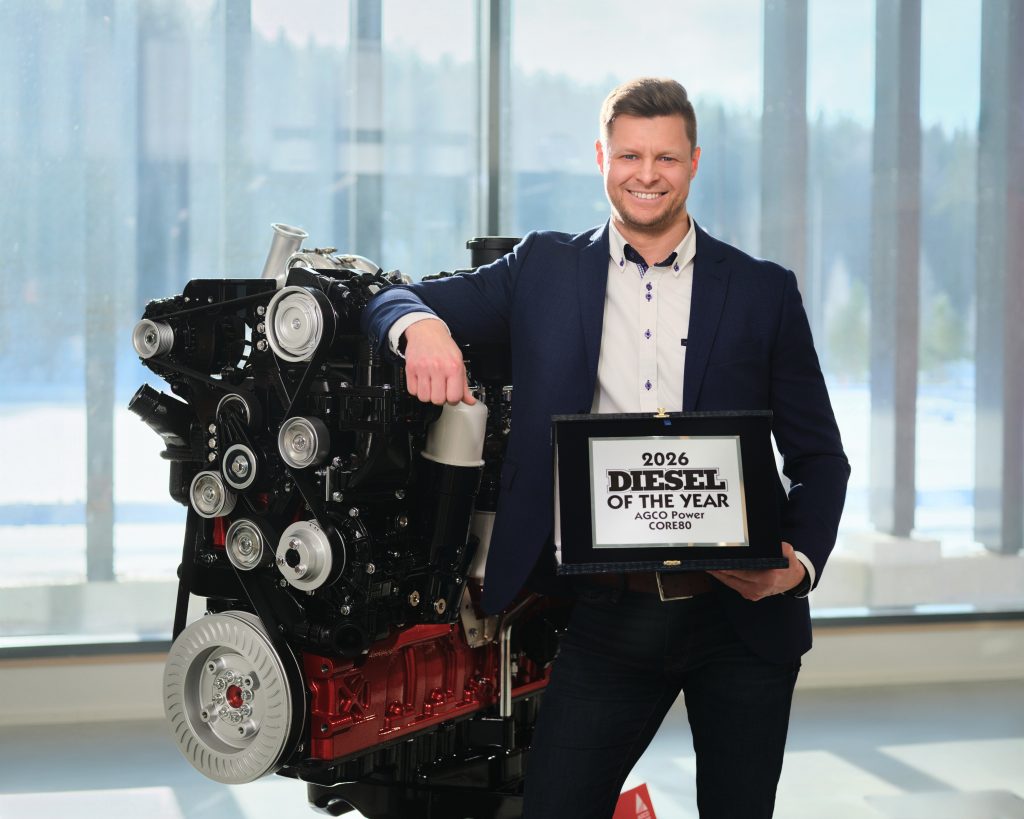
AGCO Power’s new CORE engine family has already proven to be highly fuel efficient in numerous tests, but what do tractor users say? They confirm the measurement results and list additional observations about the strengths of CORE engines. These qualities are not accidental—they are the result of carefully considered structural solutions. AGCO Power’s CORE engines are currently used in the new Fendt 500, 600, 700 and 800 Vario series tractors, and over time the engine range and the number of manufacturers using CORE engines will continue to grow.
“Perhaps the most important features of all CORE engines are performance, fuel efficiency and reliability even at low engine speeds. In addition, there are characteristics related to the tractor manufacturer and engine model that vary slightly depending on the tractor. For example, the CORE80 engine used in the new Fendt 800 Vario series offers excellent torque and response thanks to the variable-geometry turbocharger, and the tractor’s cab has been made very quiet through effective sound insulation,” says Juha-Pekka Asikainen, Project Manager of the Core engine family.
In Fendt tractors, AGCO Power’s CORE engine is paired with the stepless Vario transmission. The entire powertrain is designed to work as one system.
“With the Fendt iD low-speed concept, the six-cylinder tractor delivers maximum power already at 1500–1700 rpm, instead of the conventional 2100 rpm. The four-cylinder CORE engine delivers its maximum power at 1700–1900 rpm. Low engine speed reduces fuel consumption, lowers noise levels and extends engine life,” Asikainen explains.
Farmer–contractor: “Agile, tough and fuel efficient”
Brothers Vesa and Ari-Pekka Hirvonen run a cereal farm and provide contracting services in Kuhankoski, Laukaa, Finland. They currently use a Fendt 728 Vario tractor equipped with AGCO Power’s CORE75 engine.
“It’s a tough engine. Our farthest fields are 25 kilometres away. When driving back with a three axle 29 cubic metre grain trailer, the speed drops slightly below 60 km/h on the steepest hills, but the engine pulls without any problems,” says Vesa Hirvonen.
They also haul a 14-ton excavator on a lowbed trailer and use fivefurrow reversible ploughs, a 3.5-meter cultivator and a 7 metre harrow. Previously they used a Fendt 933 Vario with about 20 more horsepower and two tonnes more weight. The new tractor performs the same work but with lower fuel consumption and greater agility.
“Yesterday I spent nine hours clearing snow from nearby roads and yards. Productive working time was 92 percent, and idling 8 percent. Average fuel consumption was 11.04 litres per hour. I don’t think that’s bad at all for a 303 horsepower tractor,” Vesa notes while checking the tractor’s mobile app.
“The engine is also very quiet, and the tractor is narrow around the front wheels, which makes it extremely agile for its size. The low operating speed also reduces noise, both on the road and in general,” adds Ari-Pekka.
“The tractor is also very easy to drive. The new stepless transmission has only one speed range, and all boost functions operate automatically, so all you really need to do is press the accelerator and steer.”
The Hirvonens always take their tractors to authorised service. In the CORE engine, filters, the dipstick and other service points are positioned next to each other. The Fendt 728 Vario has been with them for just over six months and has accumulated 500 hours.
“They are conveniently placed, but we haven’t really had to touch them—except to check the dipstick. Maybe that says something about reliability: we haven’t had to open the hood. We’ve been able to focus on work instead of engine maintenance.”

Fendt ordered, AGCO Power delivered
Fendt is known as a demanding customer for component suppliers. When developing the fifth-generation Fendt 800 series, Fendt defined the target characteristics for the engine—such as dimensions, torque and power curves, fuel consumption maps, and cold-start capability—based on which AGCO Power developed the necessary technical solutions. The achievement of these targets was closely monitored throughout the project in cooperation with the customer.
“However, the basic characteristics of the engine were not designed solely for Fendt. Future needs were also taken into account. The CORE engine’s fundamental structure allows further development, for example for future fuels, hybrid-electric use, and applications beyond tractors, such as other heavy machinery. The engine can also be equipped with different oil pans so that it can either be mounted on a subframe or act as a self supporting structural component, with the tractor’s front axle attached to the oil pan.”
Traditionally, AGCO Power engines have been designed for off road machinery, not road transport, unlike many other diesel engines used in work machines. This is reflected in their robust structure—for example, the crankshaft is very strong. Similarly, the cylinder block and head withstand high pressures, enabling high performance even at low engine speeds.
One aspect of reliability is a relatively simple structure. CORE engines do not use EGR exhaust gas recirculation; emissions are managed with SCR aftertreatment. AGCO Power was the first manufacturer of off road engines to adopt SCR technology and therefore has the longest experience with it. AGCO Power’s product development includes a highly experienced emissions control team responsible for all of the company’s aftertreatment solutions. The more efficient the aftertreatment system, the fewer compromises are needed in the CORE engine’s performance. The excellent performance of CORE engines has been achieved with the use of a single turbocharger, which further enhances reliability. Another highly valued feature—especially in cold climates—is intake air preheating and the option to install a traditional block heater.
“Today we can simulate and calculate engine performance far more widely and accurately than before. For example, the CORE engine’s operation was extensively simulated and modelled even before the first prototype was built. When the first prototype engine entered testing, it was significantly more refined than the first prototypes in our previous engine projects,” says Asikainen.