


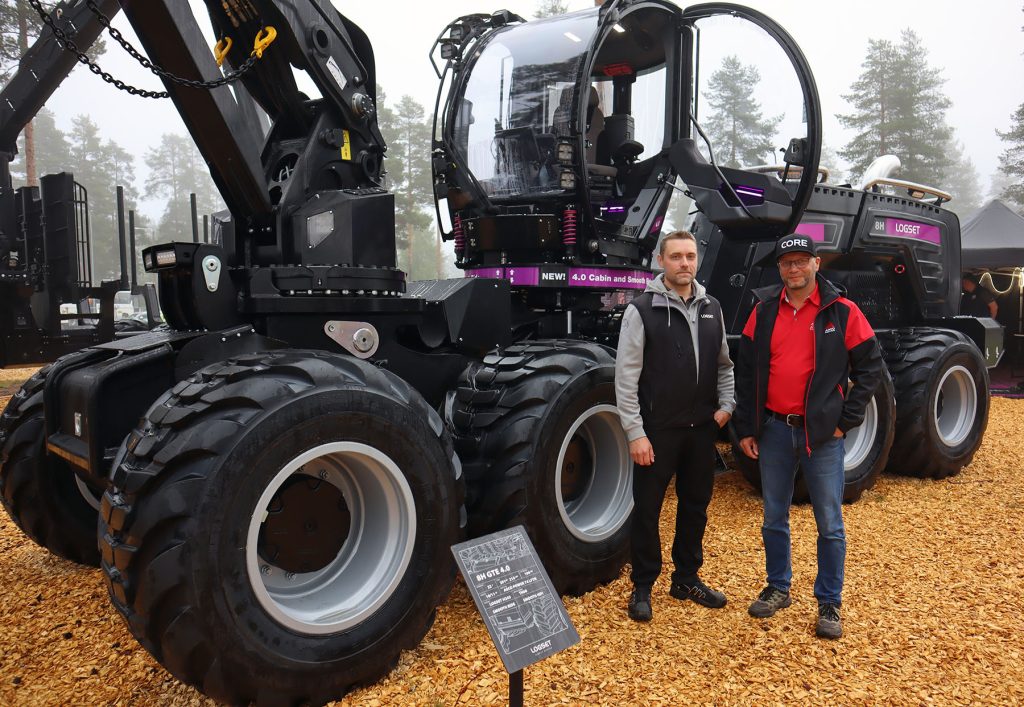
“Forestry applications place very different demands on an engine than on-road applications do,” says Juha Tervala, Managing Director at AGCO Power. Juha Tervala and Andreas Eurs, Product Manager at long-standing partner Logset, are pictured presenting Logset’s new 8H GTE 4.0 Hybrid harvester, powered by an AGCO Power engine.
Modern forestry machines work in some of the most demanding conditions in the off-road world. Harvesters and forwarders operate far from workshops, under rapidly changing loads and in environments where uptime, fuel efficiency and serviceability have a direct impact on productivity.
“Forestry applications place very different demands on an engine than on-road applications do. The engine must respond instantly to changing loads, work seamlessly with the machine’s hydraulic and control systems, and keep it productive in conditions where downtime is costly,” says Juha Tervala, Managing Director at AGCO.
- AGCO Power will present its modern diesel engines designed for forestry machinery at INTERFORST 2026, held at Messe München on 15–18 October.
- Find AGCO Power at Interforst: Systems & Components area, booth B6.141
At INTERFORST, AGCO Power will present modern diesel engines designed for forestry machinery and other demanding off-road applications. The new CORE engine family combines fast load response, excellent fuel efficiency, easy serviceability and long-term reliability. In forestry applications, these are not just technical features, but business-critical requirements.
“Modern diesel technology continues to develop. When an engine is designed from the start for off-road machinery, the benefits are visible to the customer: lower fuel use, strong response, easier service and dependable performance in demanding conditions,” says Jarno Ratia, Director of Product Management of AGCO Power.
Designed for demanding off-road work
Forestry places very specific demands on an engine. In a harvester, the load changes rapidly as the head feeds, delimbs and cuts timber. In a forwarder, the engine must deliver controlled power when moving heavy loads over uneven terrain, slopes and soft ground.
In these conditions, reliable operation is not only about power and torque. The engine must also maintain dependable lubrication and performance when the machine is working on inclines or in tilted positions, as forestry machines often operate on uneven ground for extended periods. The engine must be matched to the machine’s hydraulics, cooling package, aftertreatment system, lubrication, software and service layout.
“Performance in forestry is created by the whole machine. The engine, hydraulics, software and serviceability must be designed as one integrated system,” says Ratia.
The CORE platform is designed around high torque, low engine speeds, strong efficiency and future adaptability. The architecture also supports future powertrain technologies such as hybridization and alternative fuels.
The modular off-road engine platform, designed to support future powertrain technologies, offers today three options for different power requirements: the four-cylinder CORE50 (165 kW / 950 Nm), the six-cylinder CORE75 (250 kW / 1,450 Nm), and the newest variant, CORE80, rated at 252 kW with 1,680 Nm of torque.
Easy serviceability supports uptime
In forestry, reliability and serviceability are direct parts of productivity. Machines often operate far from workshops and service locations.
With more than 75 years of engine development experience, AGCO Power works closely with machine manufacturers to ensure that the engine, cooling, lubrication, controls and installation function as one complete system.
AGCO Power’s modern engine solutions are designed with practical serviceability in mind. The CORE engines, for example, achieve low emissions without exhaust gas recirculation, or EGR, which supports a simpler engine layout and helps improve reliability.
For forestry applications, easy access to service points, a clear engine layout and effective integration of the engine into the machine are important design priorities. When maintenance is needed, easy access to filters, daily maintenance points and key engine components can make a significant difference to uptime.
“Good serviceability supports both people and productivity. In cold, dark or remote conditions, a well-designed service layout makes routine maintenance more ergonomic and efficient, while helping the machine return to productive operation sooner,” says Jarno Ratia.
Proven fuel efficiency in independent DLG PowerMix testing
Fuel efficiency is one of the strongest advantages of AGCO Power’s modern CORE engines. It reduces operating costs, supports lower emissions and helps machine owners improve profitability over the lifetime of the equipment.
Independent DLG PowerMix testing has demonstrated the efficiency of AGCO Power CORE engines in demanding real-world operating cycles. The tests are carried out by the German Agricultural Society, commonly known as DLG, and simulate a wide range of work applications, from heavy field work to road transport. AGCO Power notes that the tests are not limited to full-load operation, but cover various load points and engine speed ranges, making the results relevant for many types of off-road machinery.
In recent DLG PowerMix comparisons, Fendt Vario tractors equipped with AGCO Power CORE engines and Fendt VarioDrive continuously variable transmissions achieved leading results in their respective power classes. The results are documented in DLG PowerMix test reports:
- Fendt 620 Vario with the CORE50 engine (maximum engine power 165 kW) achieved average field-work diesel consumption of 245 g/kWh (+29.3 g/kWh AdBlue) in DLG Test Report 7547. In the report, DLG compares the tractor with PowerMix 2 tractors in the 165 kW ±20 kW power range; those comparison results range from 263 to 295 g/kWh, making the Fendt 620 Vario the lowest diesel-consumption result shown in that comparison group.
- Fendt 724 Vario Gen7.1 with the CORE75 engine (193 kW) recorded average field-work diesel consumption of 242 g/kWh (+26.1 g/kWh AdBlue) in DLG Test Report 7552. In transport testing, it recorded 321 g/kWh at 40 km/h, 324 g/kWh at 50 km/h and 326 g/kWh at 60 km/h.
- Fendt 728 Vario Gen7 with the CORE75 engine (223 kW) recorded average field-work diesel consumption of 242 g/kWh (+24.2 g/kWh AdBlue) in DLG Test Report 7435. Its 40 km/h transport result was 332 g/kWh (+33.3 g/kWh AdBlue). The DLG-hosted test material states that the tractor was more economical than the average of previously tested tractors in every PowerMix cycle and, at the time of testing, was the most economical tractor measured in transport.
- Fendt 832 Vario with the CORE80 engine (252 kW) achieved average field-work diesel consumption of 235 g/kWh (+29.0 g/kWh AdBlue) in DLG Test Report 7599. DLG’s report shows a range of 240–301 g/kWh for other tractors in its 252 kW ±20 kW comparison, while the Fendt 832 Vario achieved 235 g/kWh.
Across the Fendt, Massey Ferguson and Valtra brands, measurable fuel efficiency gains are achieved through the combination of proven engine technology and brand-specific driveline integration. The best results come when the engine, transmission, hydraulics and software work together.
“Lower fuel consumption immediately affects operating costs. But efficiency cannot come at the expense of response, durability or uptime. That balance is where AGCO Power’s off-road experience makes the difference,” says Ratia.